Quick Medical Record: Leyte’s Digital Health Breakthrough
Insights from the Field
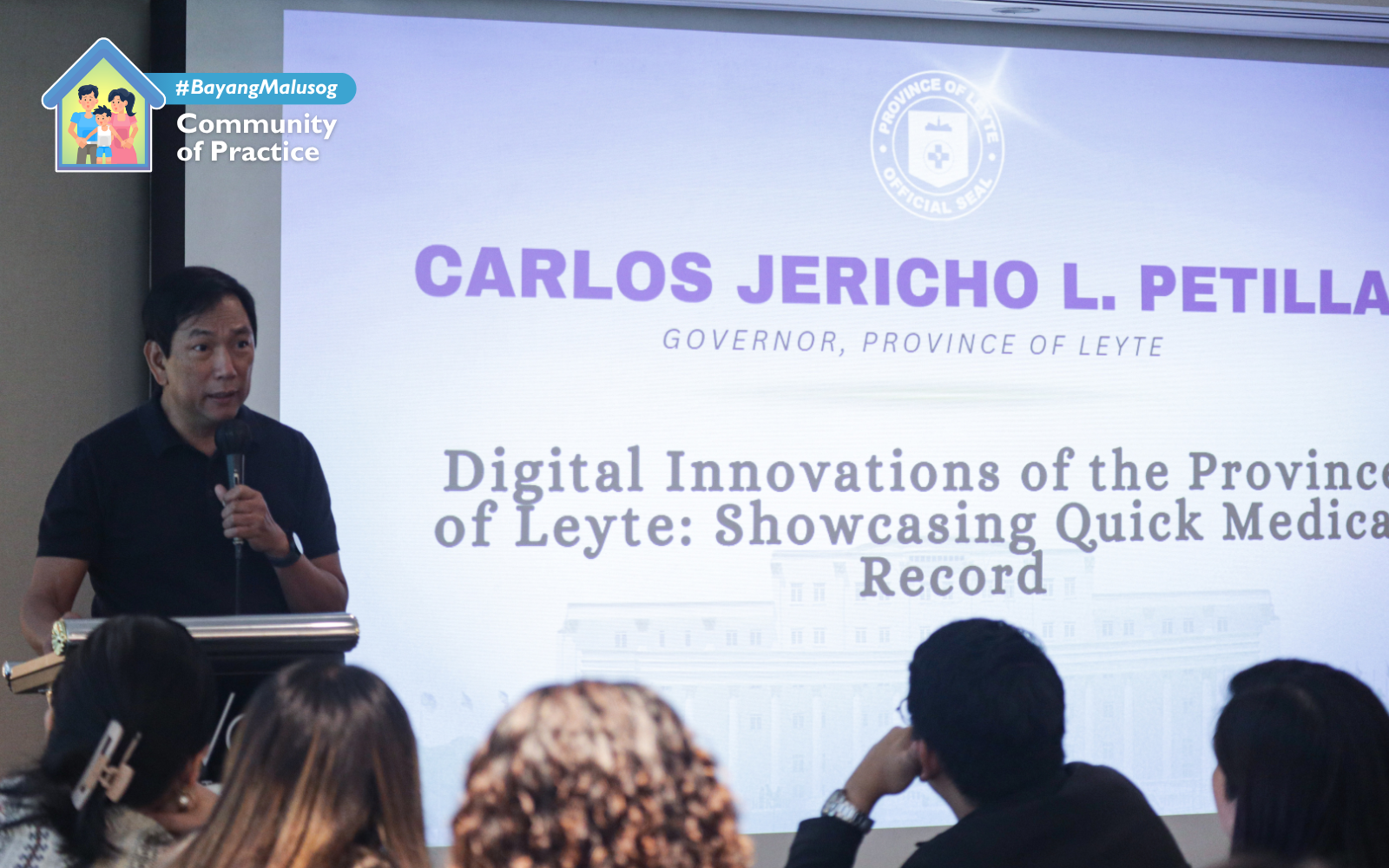
Leyte Governor Carlos Jericho Petilla
As part of the Zuellig Family Foundation (ZFF)’s Bayang Malusog Community of Practice session on Health Information System (HIS) Strengthening, the Province of Leyte presented a strong example of the influence of local health leaders to use digital innovation and improve healthcare delivery and patient management.
Leyte Governor Carlos Jericho Petilla shared the province’s experience in implementing its locally-developed HIS, the Quick Medical Record or QMeR, not just as a technology project, but as a strategy in achieving Universal Health Care (UHC).
Governor Petilla emphasized that health is a primary concern for every family because one serious illness can wipe out a person’s savings. For him, a successful healthcare system must address not only service delivery, but also proper financing, accurate claims, and efficient use of resources. This is why Leyte designed QMeR to capture data at the point of care, ensuring that patient information is available when and where it is needed.
QMeR also supports Leyte’s PhilHealth claims processing by improving report generation and electronic claims transmission. Because of QMeR, Leyte reported that its provincial hospital sees around 65% of claims paid within 30 days, with a return-to-hospital rate of only about 2-3%.
Another key feature of QMeR is its electronic referral function. Governor Petilla stressed that UHC cannot function without a proper referral system. Through QMeR, patients referred from rural health units (RHUs) to hospitals can be accepted digitally. Their records are shared and made available by the receiving facility, which reduces duplication of diagnostic tests and improves continuity of care.
Leyte is also currently exploring artificial intelligence (AI) as part of the back-end support for QMeR. As summarized by Governor Petilla, AI can help amplify diagnostic capability by supporting health workers in tasks such as transcribing voice orders, suggesting appropriate ICD-10* codes, assisting in clinical diagnostics, and providing instant readings for X-rays and electrocardiograms—all with validation and confirmation from health professionals. A public health surveillance dashboard was also demonstrated, showing how AI can help track disease trends, epidemic thresholds, and map cases.
Despite these advancements, Governor Petilla acknowledged that there are still challenges, including connectivity, hardware procurement, training personnel, and municipal-level adoption of QMer. He noted that some health workers may resist using tablets or digital tools, while others remain cautious about AI.
Leyte’s experience highlights an important lesson that health digitalization must be supported by leadership, policy, infrastructure, and a willingness to change old practices. With QMeR, Leyte shows how a locally developed system can turn health data into a tool for a more accountable public health management.
—
On May 6, 2026, ZFF convened the Bayang Malusog Community of Practice—a learning platform for health officials across the Philippines—to strengthen HIS as the backbone of health reform. The session brought together 17 provinces, one city, and representatives from five DOH regional offices, each sharing diverse operational realities and digital health maturity levels to advance UHC. Read more about the event here.
* 10th revision of the International Statistical Classification of Diseases and Related Health Problems